The USA student visa for international students — formally known as the F-1 visa — is the single most important document in your study abroad journey. Without it, even the most competitive university admission means nothing. Yet for many students, the visa process is the most confusing and anxiety-inducing part of the entire application. This guide removes that uncertainty entirely.
In 2026, the US Department of State has introduced updated procedures including dedicated “Student Visa Season” scheduling for F-1, M, and J applicants to reduce wait times during peak periods. The total cost of obtaining a USA student visa for international students remains approximately $535, and the interview — while brief, typically lasting under three minutes — remains the most critical stage of the process. Here is everything you need to know, step by step.
What Is the USA Student Visa for International Students?
The F-1 visa is a non-immigrant visa issued by the US government to international students who wish to pursue full-time academic study at a SEVP-approved institution in the United States. SEVP — the Student and Exchange Visitor Program — is the US government’s certification system for universities and colleges that are authorised to enrol international students.
The F-1 visa is valid for the duration of your academic program as stated on your I-20 form, plus a 60-day grace period after graduation. It allows you to work on campus for up to 20 hours per week during the semester, and to pursue off-campus work through authorised programs including Curricular Practical Training (CPT) and Optional Practical Training (OPT). STEM graduates are eligible for an extended OPT period of up to 36 months after graduation — one of the most significant advantages of studying in the USA for students in technology and engineering fields.
Over 1.1 million international students currently hold F-1 status in the United States, making it by far the most commonly issued student visa in the world. Understanding the USA student visa process for international students thoroughly before you begin significantly improves your chances of a smooth, successful application.
USA Student Visa Requirements for International Students in 2026
Before you begin your F-1 visa application, you must meet the following core eligibility requirements:
- You must have received an offer of admission from a SEVP-certified US university or college
- You must have received your Form I-20 from your institution’s Designated School Official (DSO)
- You must demonstrate sufficient financial resources to cover tuition, living expenses, and travel for the full duration of your program
- You must show clear intent to return to your home country upon completion of your studies — this is one of the most scrutinised aspects of the F-1 interview
- You must not have any prior US visa violations or immigration issues that would make you ineligible
In 2026, US Embassy officers are placing increased emphasis on two specific areas: financial credibility and academic intent. Your financial documents must precisely match the amounts stated on your I-20, and your study plans must be clear, specific, and consistent across all your application documents.
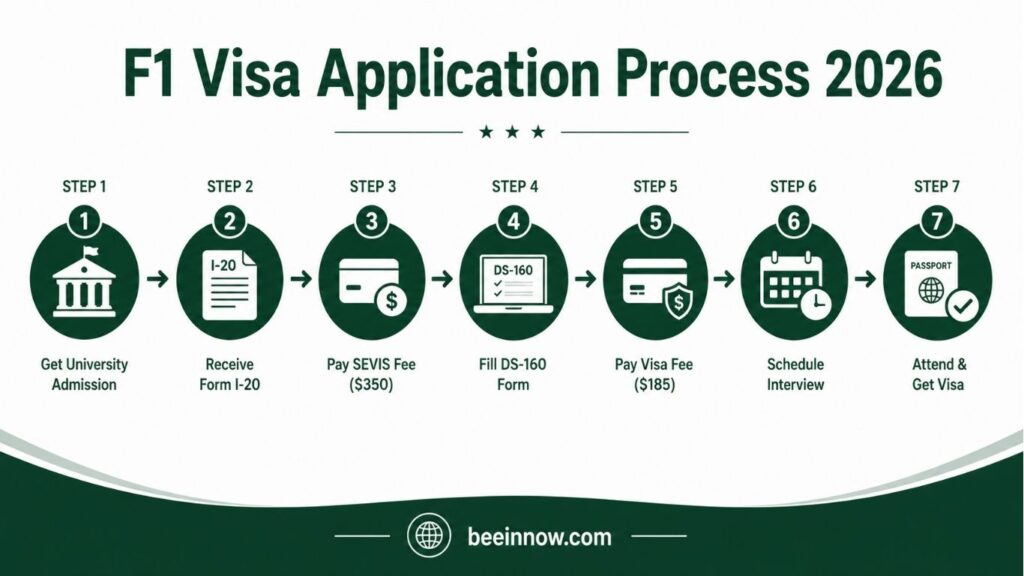
Step-by-Step F1 Visa Application Process for International Students
The USA student visa application process for international students follows a specific sequence. Each step must be completed in order — skipping or reversing steps is one of the most common mistakes applicants make.
Step 1: Get Accepted and Receive Your I-20
The process begins with your university admission. Once accepted by a SEVP-certified institution, your Designated School Official will issue your Form I-20 — the Certificate of Eligibility for Nonimmigrant Student Status. This document is the foundation of your entire visa application. It records your SEVIS ID number, your program dates, your field of study, and the estimated annual cost of attendance. Every detail on your I-20 must be accurate and consistent with all other documents you submit.
Understanding the complete USA student visa for international students process before you begin saves significant time and reduces the risk of costly mistakes.
Step 2: Pay the SEVIS I-901 Fee
Before doing anything else, pay the SEVIS I-901 fee of $350 at fmjfee.com. This fee funds the Student and Exchange Visitor Information System — the database that tracks international students throughout their time in the USA. Save your payment receipt carefully. You will need it at your visa interview and when you arrive at the US border.
Step 3: Complete the DS-160 Form
The DS-160 is the official online nonimmigrant visa application form, completed at the US State Department’s CEAC portal (ceac.state.gov). This form is the backbone of your application — every detail must be 100% accurate. Inconsistencies between your DS-160 responses and your interview answers are the most common reason for 214(b) visa refusals in 2026. Take your time completing it, double-check every field, and save your confirmation page with its barcode — you will need it at your interview.
Step 4: Pay the Visa Application Fee
Pay the MRV (Machine Readable Visa) application fee of $185 through your nearest US Embassy’s designated payment portal. This fee is non-refundable regardless of the outcome of your application. Keep the receipt — it is a required document for your interview.
Step 5: Schedule Your Visa Interview
Book your visa interview appointment at the nearest US Embassy or Consulate as early as possible. In 2026, the US Embassy has introduced dedicated Student Visa Season scheduling for F-1, M, and J applicants to reduce wait times during the peak May–July period. However, in high-volume countries like India, China, and Nigeria, wait times can still extend to several weeks or months. Start at least three to six months before your program start date.
Note that as of September 2025, the Department of State updated its Interview Waiver policy — most nonimmigrant visa applicants, including F-1 students, are now required to attend an in-person interview regardless of prior visa history.
Step 6: Attend Your Visa Interview
The F-1 visa interview is typically brief — in 2026, most interviews last under three minutes. However, those three minutes are decisive. Consular officers are assessing two things above all else: that you are a genuine student with clear academic plans, and that you have credible financial support with demonstrated intent to return home after graduation.
Bring every document in an organised folder. Speak naturally and honestly — officers are experienced at identifying rehearsed, scripted answers. Know your numbers: be ready to state your tuition fees, your sponsor’s annual income, and your GPA without hesitation or reference to notes.
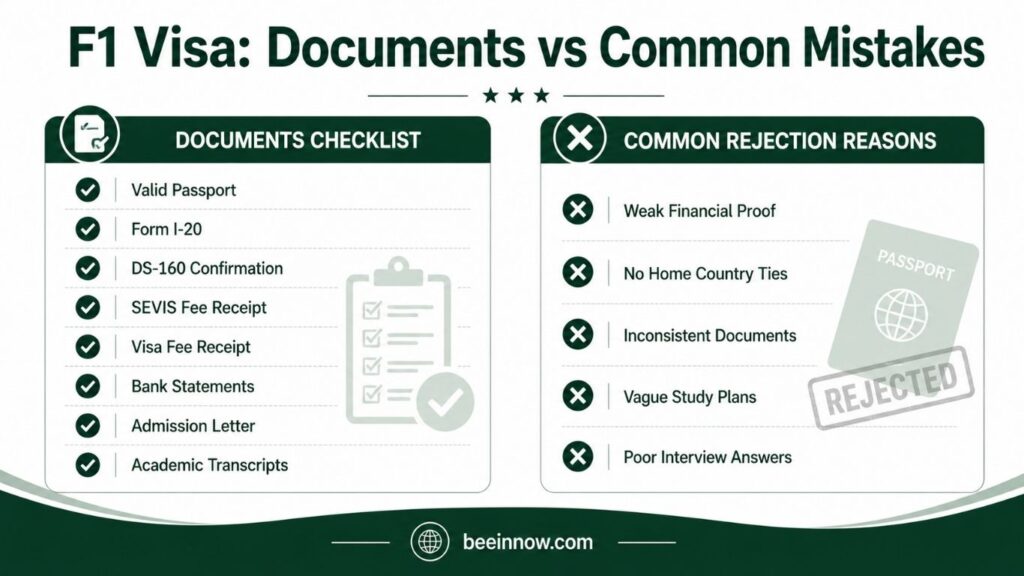
Required Documents for the USA Student Visa Interview
Organise the following documents before attending your F-1 visa interview:
- Valid passport — must be valid for at least six months beyond your intended period of stay
- Form I-20 issued by your university
- DS-160 confirmation page with barcode
- SEVIS I-901 fee receipt
- MRV visa application fee receipt
- Interview appointment confirmation letter
- Financial proof — bank statements for the last three to six months showing sufficient funds to cover your first year of study
- University admission letter
- Academic transcripts, degrees, and certificates from previous institutions
- Standardised test score reports (GRE, GMAT, TOEFL, IELTS)
- Two recent passport-sized photographs meeting US visa photo requirements
- Evidence of ties to your home country — property documents, family details, employment records — to demonstrate intent to return
F1 Visa Fees for International Students in 2026
Understanding the full cost of the USA student visa process helps you plan your finances accurately. The table below summarises all applicable fees:
| Fee Type | Amount (USD) | Where to Pay | When to Pay |
|---|---|---|---|
| SEVIS I-901 Fee | $350 | fmjfee.com | Before DS-160 |
| Visa Application (MRV) Fee | $185 | US Embassy portal | Before interview scheduling |
| DS-160 Form | Free | ceac.state.gov | After SEVIS payment |
| Visa Issuance Fee (select countries) | Varies | At Embassy | After approval |
| Total Estimated Cost | ~$535 | — | — |
Note that some nationalities are subject to an additional visa issuance fee after approval, which varies by country of citizenship. Always check the US Embassy website for your specific country before budgeting.
Budgeting accurately for your USA student visa for international students application ensures no surprises during the process.
F1 Visa Interview Tips for International Students
The visa interview is where many otherwise strong applications fail — not due to document issues, but due to poor communication during the interview itself. Here are the most important things to keep in mind for your 2026 F-1 interview:
Be specific about your study plans. Vague answers like “I want to get a good education” raise immediate flags. Instead, be ready to explain exactly which program you are joining, why you chose that specific university, and how the degree connects to your career goals back home.
Demonstrate financial clarity. Know your exact tuition fees, your sponsor’s income, and the source of your funding. If your bank balance recently increased significantly, be prepared to explain where the funds came from — large, unexplained deposits are a red flag for consular officers.
Establish strong home country ties. This is the most common reason for F-1 visa refusals under section 214(b) of the Immigration and Nationality Act. Officers need to be convinced that you will return home after graduation. Family commitments, property ownership, or a job offer in your home country all strengthen this case.
Keep your social media profiles public. The US Department of State conducts online presence reviews for all F, M, and J visa applicants. Ensure your social media activity is consistent with the profile of a genuine student.
Never make final travel plans before visa approval. Book refundable tickets only, and do not resign from employment or make irreversible commitments until you have your visa stamped in your passport.
Preparing thoroughly for your USA student visa for international students interview is the single most important thing you can do to improve your approval chances.
How Long Does the F1 Visa Take to Process?
In most cases, F-1 visa decisions are given immediately at the end of the interview. If approved, your passport will be retained for visa stamping and returned to you — typically within three to five business days via courier. Some applications require additional administrative processing, which can add several weeks to the timeline.
You can apply for your F-1 visa up to 365 days before your program start date, but you cannot enter the USA more than 30 days before your classes begin. Given the potential for delays in scheduling and processing, starting your application at least three to six months in advance is strongly advised.
What Happens After Your F1 Visa Is Approved?
Visa approval is not the final step — it is the beginning of your F-1 status obligations. Upon arrival in the USA, complete your SEVIS check-in with your university’s international student office within the first few days. Failure to check in promptly can result in your SEVIS record being deactivated.
Maintain full-time enrollment throughout each semester. Report any changes to your program, address, or employment status to your DSO. Keep your passport, I-20, and visa stamp documents safe — you will need them every time you re-enter the USA after international travel.
For STEM graduates planning to extend their stay through OPT, begin the application process at least 90 days before graduation — USCIS processing times for the I-765 Employment Authorization Document currently run three to five months.
Common Reasons for F1 Visa Rejection
Understanding why USA student visas for international students get rejected is as important as knowing the application process itself. The most frequently cited reasons include insufficient or inconsistent financial documentation, inability to demonstrate clear intent to return home after graduation, vague or unconvincing study plans, discrepancies between DS-160 responses and interview answers, and prior US immigration violations.
A 214(b) refusal is not permanent. If your application is denied, you can reapply after addressing the specific weaknesses in your previous application. However, there is no appeal process — each new application is treated independently and requires all fees to be paid again.
Final Thoughts
The USA student visa for international students is a rigorous but entirely navigable process when approached with proper preparation. The students who succeed are not necessarily those with the highest grades or the most prestigious university offers — they are the ones who understand exactly what the consular officer needs to see and present their case clearly, honestly, and confidently.
Start early, organise your documents meticulously, and be specific about your academic and financial plans. For more guidance on choosing the right US university and understanding the full study abroad process, visit beeinnow.com — your complete resource for studying in the USA.
The USA student visa for international students process is straightforward when you follow each step carefully and prepare your documents well in advance.
For official and up-to-date visa information, always refer to the US Department of State Student Visa page and the official SEVIS website.