Every “best engineering colleges” list looks basically the same — MIT, Stanford, Berkeley, repeat. And sure, those names aren’t wrong. But if you’re an international student trying to figure out where to spend the next two years and $60,000+, a global research ranking doesn’t tell you the things that matter most: will you get a visa-friendly job after, can you afford it without a loan that haunts you for a decade, and will the degree open doors back home or in the US. This guide looks at the best engineering colleges in USA for international students from that angle instead.
What the Rankings Actually Measure
Most lists of the best engineering colleges in USA for international students lean on the QS World University Rankings for 2026, which put MIT at #1 globally, with Stanford close behind. The US holds 192 ranked spots in engineering and technology this year — more than any other country. That’s genuinely useful information. But rankings like QS weigh things like research citations and faculty reputation heavily. Great if you’re headed for a PhD. Less useful if you’re an MS student trying to land a job at a semiconductor company in Austin within 18 months of graduating.
💡 Pro Tip: Don’t just read the overall university ranking when comparing the best engineering colleges in USA for international students. Look up the subject-specific engineering ranking for your exact discipline — a school ranked #40 overall can be top 10 in, say, industrial engineering.
Names Worth Knowing Beyond the Obvious Three
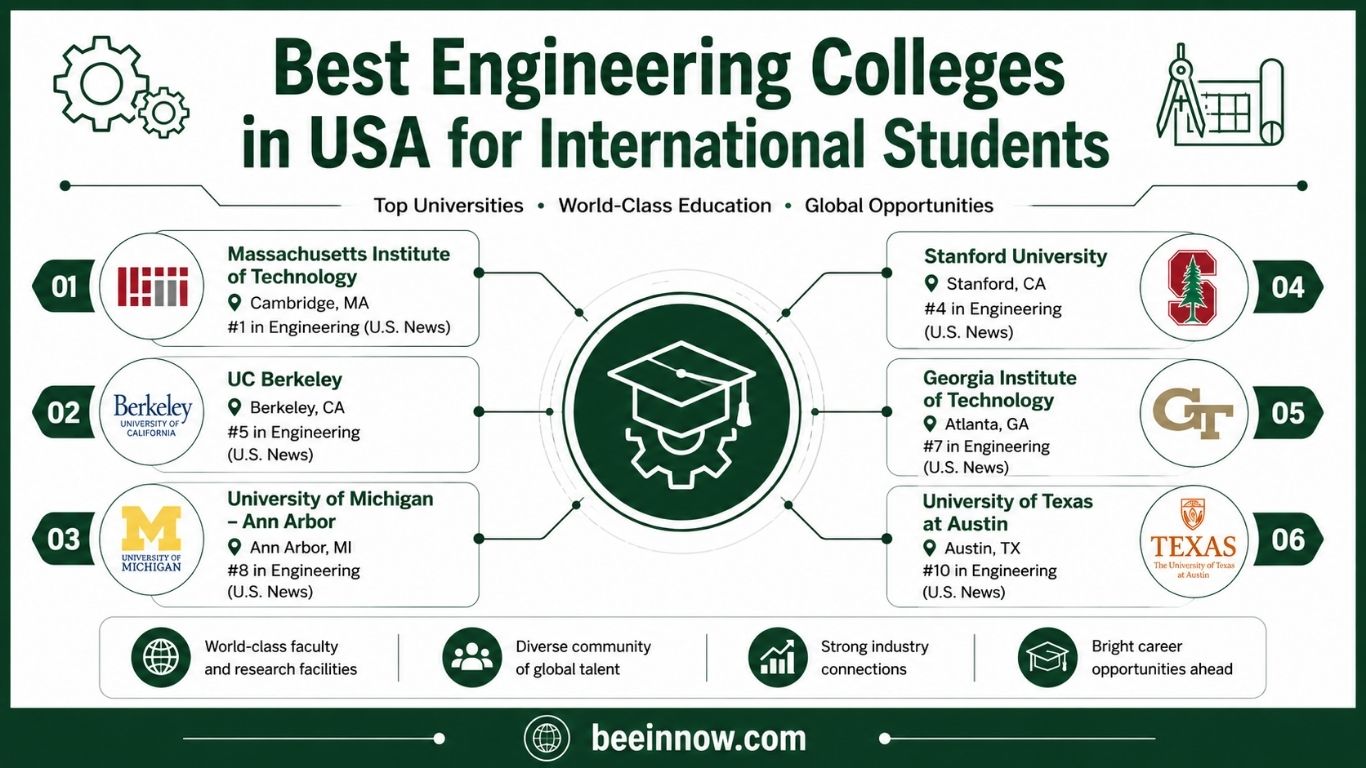
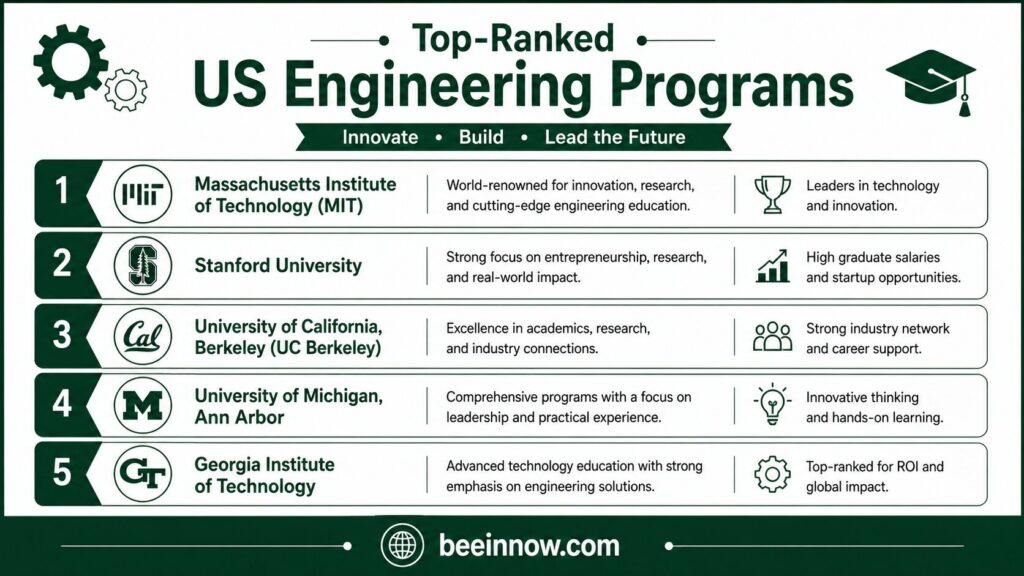
MIT and Stanford get all the attention, but among the best engineering colleges in USA for international students specifically, a handful of other schools consistently show up for the right reasons — strong industry pipelines, realistic admit rates, and international student communities big enough that you’re not the only one figuring out F-1 paperwork alone. Georgia Tech, Carnegie Mellon, Purdue, UIUC, University of Texas at Austin, and Texas A&M all come up repeatedly in this context. They’re not necessarily cheaper, but they place graduates into real jobs at a rate that matters more than a citation index.
Does ABET Accreditation Actually Matter?
Yes, more than most applicants realize, and it’s one of the quiet filters that separates the best engineering colleges in USA for international students from ones that just look good on paper. ABET accredits the program, not the university as a whole, so it’s worth checking per-department rather than assuming. If you ever want to sit for the FE or PE licensing exams — required for certain civil, structural, or environmental engineering roles — you’ll need a degree from an ABET-accredited program. Skip this check and you might find out two years too late that your dream job requires a credential you don’t have.
The Money Question Nobody Wants to Talk About
MIT’s full sticker price for 2026-27 runs close to $93,000 a year, though it does meet full demonstrated need for admitted students. Most engineering master’s programs — even at some of the best engineering colleges in USA for international students — land somewhere between $35,000 and $65,000 a year depending on the state and whether the school is public or private. Public universities in Texas, Ohio, and the Midwest tend to run cheaper than the coastal private schools, without a meaningful drop in job outcomes for most engineering disciplines.
Assistantships — teaching or research positions that come with a tuition waiver and a modest stipend — are one of the most underused paths to cutting that cost. They’re competitive, especially for international students, but professors actively look for grad students willing to work in their labs. It’s worth emailing faculty directly before you even apply.
⚠️ Warning: Some scholarship databases list opportunities that are technically restricted to US citizens or permanent residents, like the NSF Graduate Research Fellowship. Always check citizenship eligibility before you spend hours on an application.
What About After Graduation?
This is the part that should actually drive your decision more than the ranking does. Engineering degrees are almost always STEM-designated, which means you’re eligible for the 24-month STEM OPT extension on top of the standard 12 months — nearly three years of work authorization to find and keep a sponsoring employer. The best engineering colleges in USA for international students tend to be the ones with strong recruiting relationships in tech, semiconductors, or manufacturing hubs, since they convert that window into actual job offers more consistently than schools that are academically excellent but geographically isolated from major employers.
| University | Global Engineering Rank (QS 2026) | Approx. Annual Cost | Known For |
|---|---|---|---|
| MIT | #1 | ~$93,000 (full cost) | Research, AI, Robotics |
| Stanford University | #3 | ~$85,000 (full cost) | Tech industry pipeline |
| Georgia Tech | Top 15 | ~$35,000 – $45,000 | Strong ROI, affordable OOS rates |
| Carnegie Mellon | Top 15 | ~$60,000 – $70,000 | Robotics, CS-adjacent engineering |
| Purdue University | Top 20 | ~$30,000 – $40,000 | Aerospace, large international cohort |
| UT Austin | Top 20 | ~$35,000 – $45,000 | Semiconductor & tech industry ties |
How to Actually Shortlist Your Schools
Instead of starting with a ranking list, start with these four checks in order: is the specific program ABET-accredited, what’s the average time-to-hire for international grads in your discipline, what does the real cost look like after any assistantship or waiver, and does the surrounding city have companies actually hiring in your field. Run any shortlist of the best engineering colleges in USA for international students through these four filters before you touch a ranking list — a school that nails three or four out of four beats a top-10 ranked school that nails one.
Frequently Asked Questions
Is MIT really the best engineering college for international students?
It’s the top-ranked globally and has excellent outcomes, but “best” depends heavily on your discipline, budget, and career goals — plenty of students do better elsewhere for less money.
Do I need GRE scores for engineering programs in the USA?
Many top programs, including MIT and Stanford, have waived the GRE requirement for most engineering applicants as of recent admission cycles — but this varies by department, so always check the specific program.
How much does an engineering degree cost for international students?
Most master’s programs range from $35,000 to $65,000 a year in total cost, though public universities in the Midwest and South are often on the lower end of that range.
What is STEM OPT and why does it matter?
It’s a 24-month work authorization extension available to STEM-designated degree holders on top of the standard 12-month OPT, giving you closer to three years to secure long-term sponsorship.
What actually makes a school one of the best engineering colleges in USA for international students?
ABET accreditation, realistic cost after aid, and strong local hiring in your discipline matter more day-to-day than global ranking alone.
Final Thoughts
Picking from the best engineering colleges in USA for international students isn’t really about finding the highest name on a list. It’s about matching a program’s accreditation, cost, and industry connections to what you actually want to be doing three years from now. Start there, and the ranking becomes one input among several — not the whole decision.
Related reading: Check out our guides on MS in USA and Cost of Studying in USA for more on planning your engineering degree.