
The cost of studying in USA for international students in 2026 ranges from approximately $35,000 per year at affordable public universities to well over $90,000 per year at elite private institutions in high-cost cities. That is a wide range — and understanding exactly what drives those numbers is the first step toward building a budget that is realistic, comprehensive, and genuinely manageable.
What surprises most students is not the tuition — they expect that to be high. What catches people off guard is everything else: mandatory health insurance that can run $3,500 per year, textbooks that cost $200 each, visa and SEVIS fees that exceed $500 before you even board the plane, and living costs that vary by as much as $2,000 per month depending on which city you choose. This guide breaks down the complete cost of studying in USA for international students in 2026 — category by category, institution type by institution type, and city by city — so you can plan with genuine accuracy.
Cost of Studying in USA for International Students — Overview
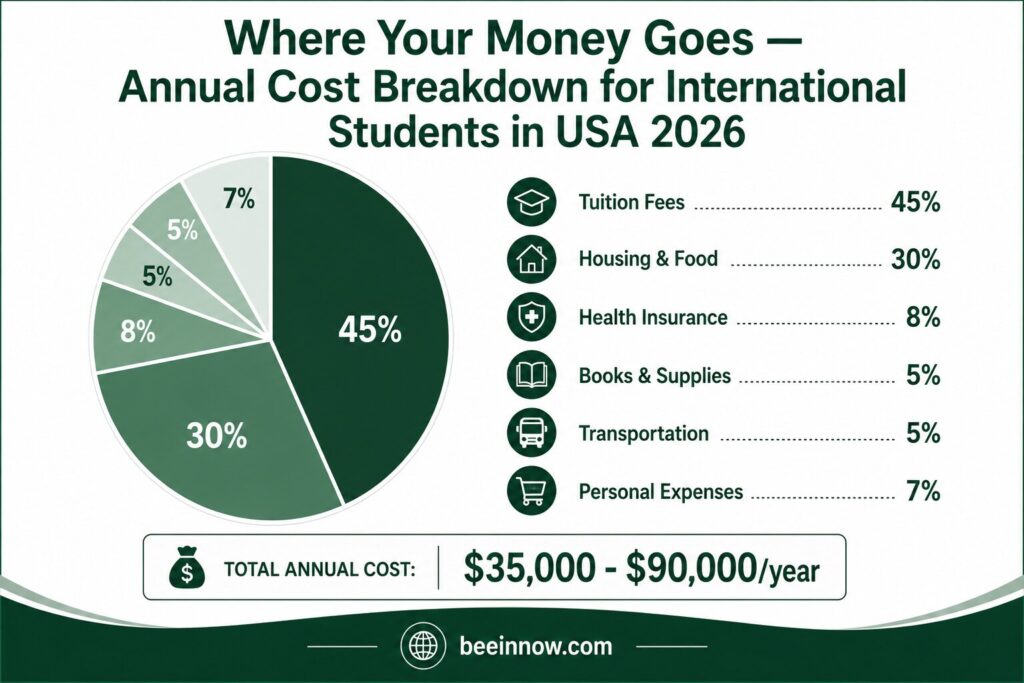
Before diving into individual expense categories, it helps to understand the overall cost picture at a high level. The cost of studying in USA for international students in 2026 can be broadly divided into two buckets: academic costs (tuition and fees) and living costs (housing, food, health insurance, transportation, and personal expenses).
According to data published by the University of Iowa for the 2026-27 academic year, a typical international undergraduate student at a mid-tier public university can expect to pay $35,442 in tuition and fees for Liberal Arts, $38,847 for Business, and $37,030 for Engineering — before a single living expense is added. Once on-campus housing ($14,022), health insurance ($2,628), and books ($950) are included, the total annual cost of attendance rises to between $53,042 and $56,916 per year. At elite private universities, the same total can exceed $90,000.
The table below provides a comprehensive comparison of expected annual costs across the three main types of US institutions:
| Expense Category | Community College | Public University | Private University |
|---|---|---|---|
| Tuition Fees | $8,000 – $15,000/yr | $25,000 – $45,000/yr | $50,000 – $80,000/yr |
| On-Campus Housing & Meals | $10,000 – $14,000/yr | $12,000 – $18,000/yr | $14,000 – $22,000/yr |
| Health Insurance | $1,500 – $2,500/yr | $1,500 – $3,500/yr | $2,000 – $3,500/yr |
| Books & Supplies | $500 – $1,000/yr | $800 – $2,000/yr | $800 – $2,000/yr |
| Transportation | $600 – $1,200/yr | $600 – $1,500/yr | $600 – $1,500/yr |
| Personal Expenses | $1,500 – $3,000/yr | $2,000 – $4,000/yr | $2,000 – $4,000/yr |
| Total Per Year | $22,100 – $36,700 | $41,900 – $74,000 | $69,400 – $113,000 |
Tuition Fees — The Largest Single Cost
Tuition is invariably the largest single component of the cost of studying in USA for international students. In 2026, annual tuition fees range from approximately $8,000 at community colleges to over $65,000 at the most prestigious private universities. The key distinctions to understand are institution type and degree level.
Community colleges offer the most affordable pathway into American higher education, with annual tuition for international students typically running $8,000 to $15,000. Many students use community colleges as a strategic entry point — spending two years completing general education requirements at lower cost, then transferring to a four-year public university to complete their bachelor’s degree. This pathway can save $30,000 to $50,000 over the course of a full undergraduate program.
Public universities charge international students out-of-state rates, which range from $25,000 to $45,000 per year in 2026. These institutions offer strong academic programs at considerably lower cost than private alternatives, and many of the most highly regarded public universities — Michigan, Purdue, UCLA, University of Texas Austin — deliver career outcomes comparable to private institutions at a fraction of the cost.
Private universities — including Ivy League institutions and selective liberal arts colleges — charge the highest tuition, ranging from $50,000 to $80,000 per year in 2026. However, the published sticker price is often not what students actually pay. Elite private universities tend to offer the most generous financial aid packages, and for students from families with demonstrated financial need, the actual cost after aid can be significantly lower than at a mid-tier public university. Harvard, for example, has committed to covering full tuition for families earning under $200,000 annually starting in 2025-2026.
Browse tuition fees for over 351 US universities at beeinnow.com to compare costs across institutions.
Housing and Accommodation Costs
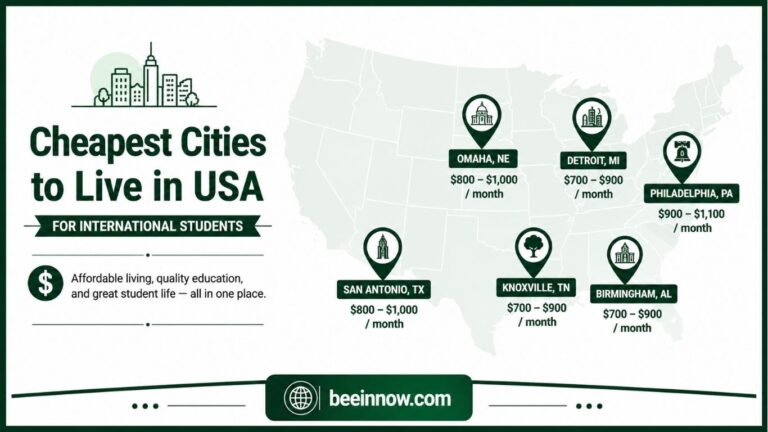
After tuition, housing is the second-largest component of the cost of studying in USA for international students — and it is the expense category most sensitive to location. A shared apartment in Houston or Columbus might cost $500 to $800 per month per person, while an equivalent arrangement in New York City or San Francisco can run $1,500 to $2,500 or more.
On-campus housing is the most straightforward option for first-year international students. Most universities require first-year students to live on campus, where a shared dormitory room plus a meal plan typically costs $12,000 to $18,000 per academic year. This includes utilities, internet, and basic furnishings — making the total cost predictable and easy to budget for. The social benefits of on-campus living are also significant for international students who are new to the USA and building their social networks.
From the second year onward, many students move to off-campus housing. Renting an apartment with two or three roommates in a mid-sized college town is typically the most cost-effective arrangement, with per-person monthly costs ranging from $500 to $1,200 depending on the city. Students should budget an additional $100 to $200 per month for utilities and internet when renting off-campus.
Health Insurance — A Non-Negotiable Cost
Health insurance is mandatory for all F-1 international students in the USA, and it is one of the most commonly underestimated components of the cost of studying in USA for international students. Unlike many countries where healthcare is publicly funded, the US healthcare system is private — and without insurance, a single emergency room visit can result in bills of $5,000 or more.
Most US universities provide their own student health insurance plans, which international students are automatically enrolled in unless they can demonstrate equivalent coverage from an alternative provider. Annual premiums for university health insurance plans in 2026 typically range from $1,500 to $3,500, though this varies significantly by institution. The University of Iowa, for example, charges $2,628 annually for its student health insurance plan in 2026-2027.
Even with insurance, students should budget for out-of-pocket costs including co-payments of $20 to $50 per medical visit and any uncovered dental or vision expenses. A realistic annual budget for health-related costs — including insurance premiums and out-of-pocket expenses — is $2,000 to $4,000.
Food Costs
Food is one of the most controllable components of the cost of studying in USA for international students, and the range is wide depending on lifestyle choices. Students living on campus with a meal plan can expect to spend $2,000 to $5,000 per academic year through their university’s dining services. Students living off-campus who cook at home typically spend $250 to $400 per month on groceries — approximately $3,000 to $4,800 annually.
Eating out regularly is the fastest way to exceed your food budget in the USA. A single restaurant meal typically costs $15 to $30 in a mid-sized city, and considerably more in New York or San Francisco. Students who cook with roommates and meal prep in advance typically manage food costs well within the $250 to $350 monthly range.
Transportation Costs
Transportation costs vary significantly depending on where you study. Students at universities in large cities with good public transit networks — New York, Chicago, Boston, Washington DC — can manage transportation costs of $50 to $100 per month using buses, subways, and metro systems. Many universities also offer free or heavily discounted transit passes to enrolled students.
Students at universities in smaller cities or suburban locations where public transit is limited face a harder choice: either rely on a bicycle and occasional rideshares, or purchase a car. Car ownership in the USA — including insurance, fuel, parking, and maintenance — can add $5,000 to $8,000 per year to your budget. Campus shuttles and student carpooling arrangements can reduce this significantly, but transportation deserves a dedicated line in your budget regardless of where you study.
Cost of Living by City — Where You Study Matters
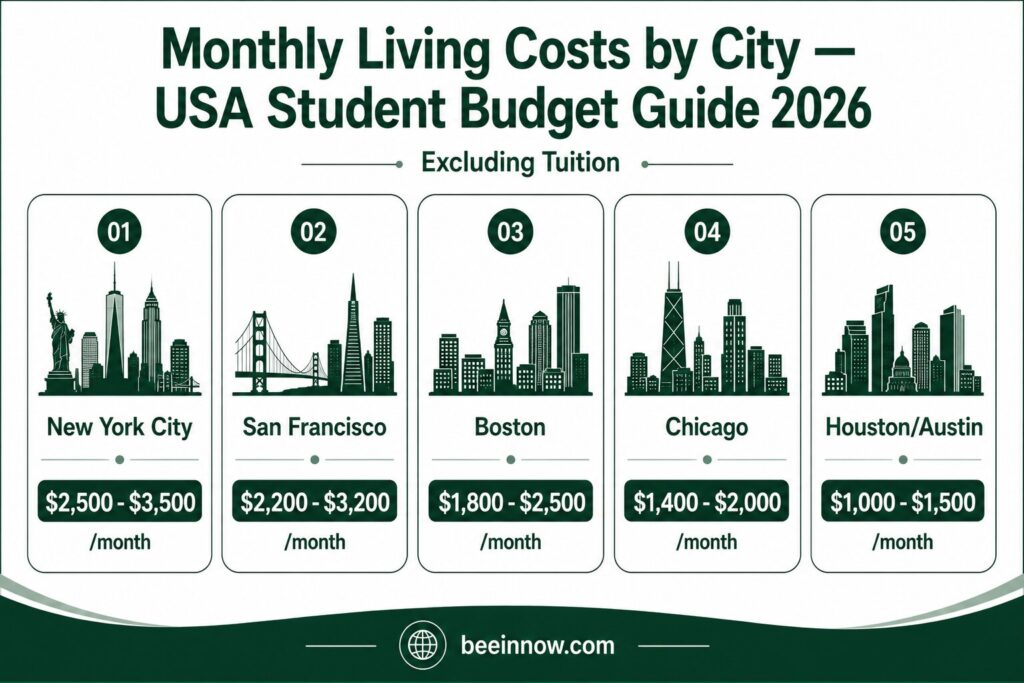
The city where you study has a profound impact on the total cost of studying in USA for international students. The same academic program at two different universities can result in annual living costs that differ by $15,000 to $20,000 purely based on location.
New York City consistently ranks as one of the most expensive cities for students, with monthly living costs — excluding tuition — running $2,500 to $3,500. San Francisco is similarly expensive at $2,200 to $3,200 per month. Boston, home to Harvard, MIT, and numerous other universities, sits in the $1,800 to $2,500 per month range.
Moving inland reduces costs substantially. Chicago offers a major-city experience at $1,400 to $2,000 per month in living costs. Cities like Houston, Austin, Columbus, Raleigh, and Tucson — all home to strong universities — offer monthly living costs in the $1,000 to $1,500 range, making them among the most cost-effective locations for international students in the USA.
Hidden and Overlooked Costs
Several costs consistently catch international students off guard when budgeting for studying in the USA. Textbooks and course materials average $800 to $2,000 per year — US textbooks are notoriously expensive, with individual titles sometimes costing $200 or more. Renting textbooks through Chegg or Amazon, buying used copies, or using digital versions can reduce this cost by 50% to 70%.
Visa and pre-departure costs are a one-time but significant expense. The F-1 visa application process costs approximately $535 in mandatory fees (SEVIS I-901 fee of $350 plus MRV application fee of $185), plus potential medical examination costs and document courier fees. Return flights to your home country should be budgeted at $800 to $2,000+ per trip depending on your origin country.
Cell phone plans run $30 to $80 per month. Prepaid plans from carriers like Mint Mobile, T-Mobile, and Visible are popular among students and significantly cheaper than contract plans. Application fees of $50 to $100 per university should also be factored into your pre-arrival budget if you are still in the application process.
University-specific fees — including technology fees, student activity fees, recreation facility fees, and international student orientation fees — can add $1,000 to $2,500 per year on top of tuition. Always check the full cost of attendance figure published by your specific university rather than relying on tuition alone when building your budget.
Money Saving Strategies for International Students
Understanding the cost of studying in USA for international students is only useful if it leads to practical strategies for managing those costs effectively. Here are the most impactful approaches.
Consider starting at a community college. The cheapest sustainable pathway through an American undergraduate degree is to complete your first two years at a community college (tuition $8,000 to $15,000 per year) and transfer to a public four-year university to complete your degree. This approach can save $30,000 to $50,000 over a four-year program without compromising the credential you graduate with.
Apply for teaching or research assistantships at the graduate level. TAs and RAs at US universities typically receive full tuition waivers plus monthly stipends of $1,500 to $3,000 — effectively eliminating tuition as a cost while providing an income to cover living expenses. This is the single most impactful financial strategy available to graduate students.
Choose your city strategically. If your academic program is available at universities in multiple locations, choosing an institution in Houston, Columbus, or Raleigh over New York or San Francisco can save $12,000 to $24,000 in living costs annually without sacrificing academic quality.
Work on campus. F-1 visa holders are permitted to work up to 20 hours per week on campus during the academic semester and full-time during breaks. Campus jobs — library assistant, lab assistant, dining hall, administrative support — typically pay $12 to $18 per hour, providing $10,000 to $18,000 in annual income to offset living expenses.
For more guidance on funding your US education, read our complete guide to Scholarships for International Students in USA.
How Much Should You Have in Your Bank Account?
US universities require international students to demonstrate sufficient financial resources as part of both the admissions process and the F-1 visa application. The amount required corresponds to the full cost of attendance published by your specific university — typically the total of tuition, housing, health insurance, and living expenses for one academic year.
For a public university with a total cost of attendance of $55,000, you will need to show bank statements demonstrating at least $55,000 in available funds. For a private university with total costs of $80,000, the requirement rises accordingly. These funds can come from personal savings, family support, scholarships, or a combination — but the documentation must clearly demonstrate the total required amount is available and accessible.
Final Thoughts
The cost of studying in USA for international students in 2026 is substantial — but it is also highly variable, and the decisions you make about institution type, location, housing, and funding strategy have a greater impact on your total cost than most students initially realise. A student who attends a strong public university in a mid-sized city, lives with roommates, works on campus, and secures even a partial scholarship can manage total annual costs well below $40,000. A student at an elite private university in New York with full financial need coverage from the institution may pay even less.
The key is to plan early, research comprehensively, and look beyond the tuition figure to understand the complete financial picture. For detailed university profiles including tuition fees and available scholarships, visit beeinnow.com.
For more related guides, read our articles on How to Study in USA, Scholarships for International Students, and USA Student Visa Guide.
For official cost of attendance data, always refer directly to your chosen university’s financial aid or admissions office website. The US Department of Education College Cost website and College Board are the most reliable external sources for tuition and cost benchmarking data.