
Knowing how to write SOP for USA universities effectively is one of the most valuable skills an international student can develop before applying to graduate programs in America. Your Statement of Purpose is the only document in your entire application that is entirely within your control — your GRE score is fixed, your GPA is fixed, and your letters of recommendation are written by others. But your SOP is yours alone, and a genuinely compelling one consistently makes the difference between admission and rejection at competitive programs, even when test scores or GPAs fall short of average benchmarks.
In 2026, writing a strong SOP for USA universities has become both more important and more scrutinised than at any previous point. Several US universities now use AI-detection tools to evaluate submitted statements, and a high AI-probability score can trigger closer scrutiny or outright rejection — particularly at competitive programs where any flag becomes a reason to move to the next applicant. This guide covers the complete process of how to write SOP for USA universities: structure, format, word count, content strategy, common mistakes, and the specific qualities that admissions committees at top US programs actually look for.
What Is an SOP for USA Universities?
A Statement of Purpose for USA universities is a personal academic essay that explains your academic background, professional experience, research interests, career goals, and — critically — why you are applying to that specific program at that specific institution. It answers the central question every admissions committee asks when reading an application: why should we admit this person over the thousands of other qualified applicants?
For graduate programs — MS and PhD — the SOP for USA universities is highly academic in tone and emphasis. Admissions committees at graduate programs are looking for evidence of research potential, academic preparedness, clarity of professional vision, and genuine fit with the program’s research areas and faculty. For undergraduate programs, the SOP is typically replaced by personal essays submitted through Common App or Coalition App, which take a more reflective and personal tone.
It is important to note that you technically write two different SOPs when applying to study in the USA: one for university admission and one as part of your F-1 visa application. These serve entirely different audiences and purposes. The university SOP focuses on your academic readiness, research interests, and program fit. The visa SOP — sometimes called a visa personal statement — focuses on your intent to study, your financial stability, and your plans to return home after graduation. This guide focuses on how to write SOP for USA universities for graduate admission purposes.
How to Write SOP for USA Universities — The Perfect Structure
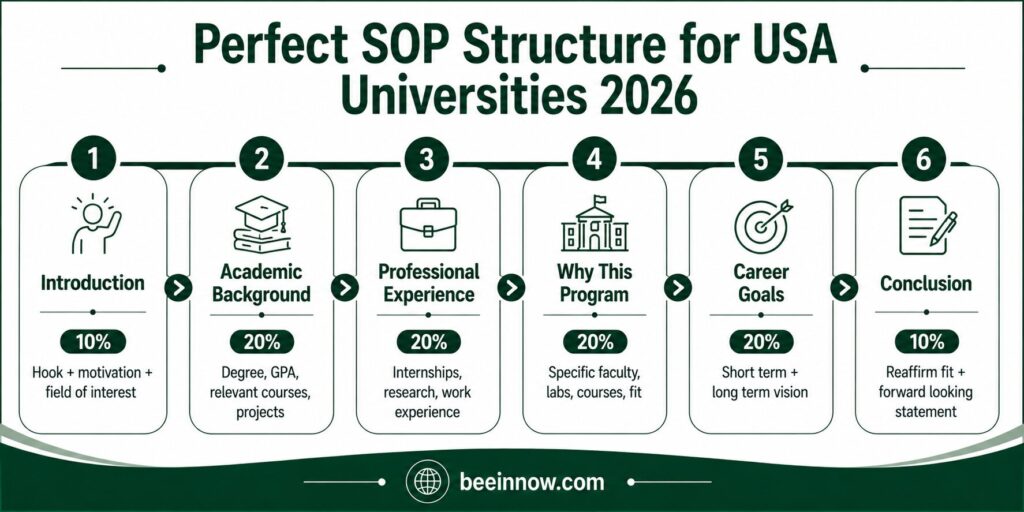
The most effective SOP for USA universities follows a clear, logical six-section structure that guides the admissions committee through your story from beginning to end. Here is the structure that consistently works across competitive US graduate programs:
Section 1 — Introduction (approximately 10% of word count)
Your opening paragraph is the most important sentence in your entire SOP. Admissions committees read hundreds of statements — the introduction determines whether they read yours with genuine interest or merely process it. The strongest openings begin with a specific, concrete moment: a research result that surprised you, a professional challenge that revealed a gap in your knowledge, or a defining observation that connected your background to your future goals. What does not work is the generic opening that approximately 60% of applicants use — statements like “Since childhood, I have always been passionate about engineering” or “It has always been my dream to study in the United States.” These openings are immediately forgettable.
A robotics kit received at age 14 that sparked curiosity about machine instructions and led to years of self-directed learning is a far more compelling opening than a declaration of lifelong passion. The difference is specificity. Be brief in the introduction — introduce your motivation and field clearly, then let the body of the SOP expand on what brought you here.
Section 2 — Academic Background (approximately 20% of word count)
This section demonstrates your academic preparedness for graduate study in the USA. Detail your undergraduate degree, relevant coursework, GPA if strong, research projects, academic awards, and any publications or presentations. The goal is not to list achievements — your transcript does that — but to explain how your academic journey shaped your research interests and skills. Connect specific courses or projects to the questions you now want to pursue at the graduate level.
If your GPA is lower than ideal, this is the place to address it — briefly and factually, without excessive apology. A semester of poor performance due to a documented health issue or family circumstance, acknowledged directly and followed by evidence of academic recovery, reads far better than a gap the committee notices but you never address. Do not lie about academic gaps or difficulties — any discrepancy between your SOP and official transcripts is a red flag that invites deeper scrutiny.
Section 3 — Professional and Research Experience (approximately 20% of word count)
For MS applications, this section covers internships, research assistant positions, industry work experience, and any independent projects relevant to your field. The emphasis here is not on listing job titles but on explaining what you learned, what problems you encountered, and how those experiences deepened your understanding of the field and motivated your decision to pursue graduate study. Each experience mentioned should connect forward to your research interests and program goals — not backward to a general interest in the subject.
For students applying straight from undergraduate with limited professional experience, this section should focus on academic research projects, lab work, thesis work, or significant course projects that demonstrate hands-on engagement with your field. Even a small undergraduate research project — if described with specificity about your methodology, findings, and what the work revealed — carries more weight than vague references to “academic interest.”
Section 4 — Why This Program (approximately 20% of word count)
This is the section that most applicants write poorly — and the one that most differentiates genuinely strong SOPs from merely competent ones. Knowing how to write SOP for USA universities means understanding that “why this program” cannot be answered with generic statements about rankings or reputation. Admissions committees know their institution’s ranking. What they want to know is whether you understand their specific program well enough to articulate why it is the right environment for your specific research goals.
Name specific faculty whose research aligns with yours — and explain precisely how. Reference specific labs, research centers, courses, or methodologies at that institution that connect to your interests. If possible, mention any prior contact with faculty members — an email exchange about research opportunities, attendance at a seminar, or a paper you read that influenced your thinking. The “why this program” section should be the most customised part of your SOP for each application — if the same paragraph appears unmodified in 12 different applications, it will be obvious to every reader.
Section 5 — Career Goals (approximately 20% of word count)
US graduate programs want to admit students with clear professional direction — not because they expect you to predict your entire career, but because clarity of purpose correlates strongly with focus, motivation, and completion rates. Describe both your short-term goals (the type of role or research position you plan to pursue immediately after graduation) and your longer-term vision (where you see yourself five to ten years into your career). Connect both directly to the skills and knowledge the specific program will provide.
Avoid vague goal statements like “I want to contribute to the field” or “I hope to make a difference.” Be specific: “I intend to pursue a research scientist role in machine learning infrastructure at a major technology firm, building toward an eventual leadership role in AI safety policy.” The specificity signals genuine planning rather than aspirational thinking.
Section 6 — Conclusion (approximately 10% of word count)
The conclusion of a strong SOP for USA universities does not simply summarise what came before — your reader just read it and will remember it without a recap. Instead, use the conclusion to leave a final, forward-looking impression: reaffirm your fit with the program, express genuine enthusiasm for the specific opportunity it represents, and close with a sentence that projects confidence in your readiness for graduate study. A conclusion that frames your path forward — the questions you plan to pursue, the contributions you intend to make — is far more memorable than one that merely thanks the reader for their consideration.
SOP Format Requirements for USA Universities in 2026
Understanding the technical format requirements is an essential part of knowing how to write SOP for USA universities. While requirements vary by institution — always check the specific guidelines on each university’s application portal — the standards below reflect what most top US programs expect:
| Element | Specification | Notes |
|---|---|---|
| Word Count | 800 – 1,200 words | Check each university’s specific limit |
| Page Length | 1 – 2 pages | Most programs: 1 page; some allow 2 |
| Font | Times New Roman or Arial, 11-12pt | Consistent throughout document |
| Line Spacing | Single or Double spaced | Follow university-specific guidelines |
| Margins | 1 inch on all sides | Standard academic format |
| File Format | PDF (preferred) | Preserves formatting across devices |
| Paragraphs | 5 – 8 paragraphs | Each 150-250 words |
| Tone | Professional & personal | Academic but not robotic |
| Start Drafting | 10-12 weeks before deadline | Allows multiple revision rounds |
| AI Detection | Avoid AI-generated content | Many US universities use AI detectors |
One format requirement deserves special emphasis in 2026: the AI detection warning. Several US universities now use AI-detection tools as part of their application review process, and a high AI-probability score — triggered by over-structured paragraphs, hedged phrasing like “it is worth noting that,” and suspiciously uniform sentence rhythm — can result in your application receiving closer scrutiny or being deprioritised in competitive cycles. If you used AI tools to assist with drafting sections of your SOP, rewrite those sections entirely in your own voice before submission. A genuine statement written by someone who knows their own story does not read like generated content — and experienced admissions readers know the difference immediately.
Common Mistakes to Avoid When Writing SOP for USA Universities
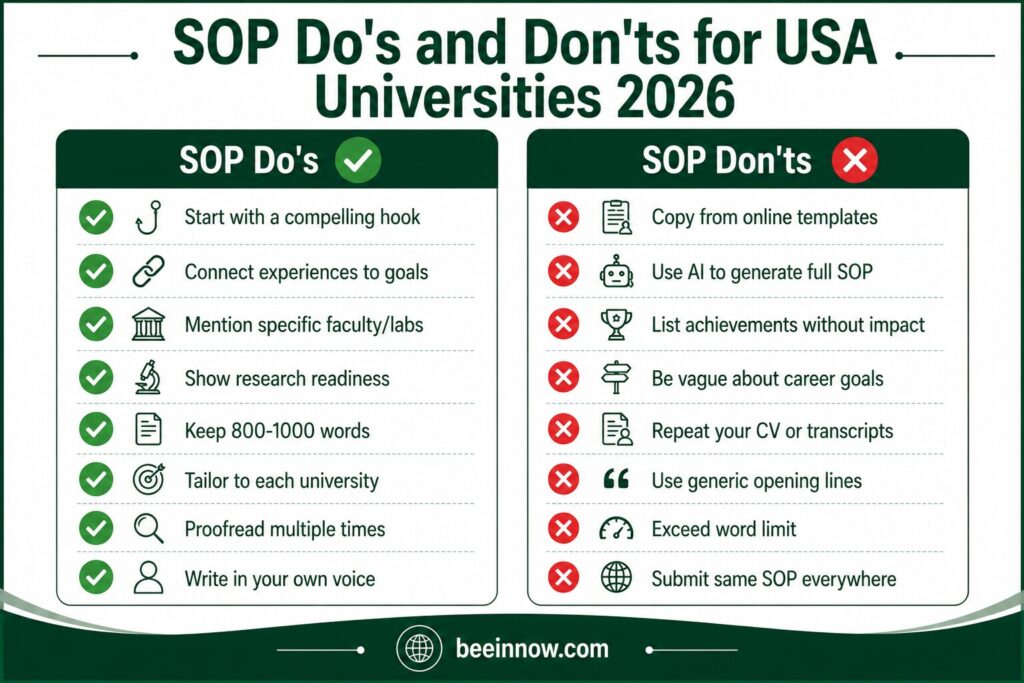
The most persistent mistake in SOPs for USA universities is listing achievements without explaining their impact. Mentioning that you completed a machine learning internship at a technology company tells the committee nothing meaningful. Explaining that the internship revealed a fundamental limitation in your understanding of probabilistic inference — and that this gap is precisely what you intend to address through graduate research — tells them everything about how you think and why you are ready for advanced study.
The second most common mistake is writing a generic SOP that reads identically whether the program name is MIT, Carnegie Mellon, or Georgia Tech. Every competitive program receives thousands of applications from students with strong academic credentials. The ones that get admitted are the ones whose SOPs demonstrate genuine knowledge of and fit with that specific program. The “why this program” section should be substantively different for each application — not just a find-and-replace of the institution name.
Starting too late is the third most damaging mistake. Students who begin drafting their SOP in November for December deadlines consistently produce weaker statements than those who started in September — not because they are less capable, but because there is simply not enough time for the multiple revision rounds that separate a good SOP from a genuinely compelling one. Begin drafting 10 to 12 weeks before your earliest deadline. This allows time for reflection, faculty contact, peer review, and the kind of substantive revision that improves an SOP dramatically from draft one to draft five.
Finally, do not copy from online samples or use AI to generate your statement. Beyond the AI detection risk, the practical problem is that a generated or copied SOP cannot reflect your specific story — and that specificity is precisely what admissions committees are looking for. No one can tell your story better than you. Your SOP should read as if only you could have written it.
SOP for USA Universities vs Visa SOP — Key Differences
Many international students confuse the university SOP with the visa SOP — they are fundamentally different documents written for different audiences with different goals. The university SOP goes to the admissions committee and focuses on your academic readiness, research interests, and program fit. The visa SOP — used in countries like Canada and Australia, though the USA does not require a separate formal visa SOP — goes to immigration officers and focuses on your genuine intent to study, your financial capacity, and your plans to return home after graduation.
For the USA specifically, your F-1 visa interview replaces the formal visa SOP. The questions an immigration officer asks at your visa interview mirror what a visa SOP would address: why you want to study in the USA, why you chose this program, how you will fund your education, and what your plans are after completing your degree. Your university SOP and your visa interview answers should be consistent — any significant discrepancy between what you wrote in your SOP and what you say at the visa window is a red flag.
How Long Should an SOP for USA Universities Be?
The standard word count for an SOP for USA universities is 800 to 1,200 words — though specific programs may set their own limits. Harvard Graduate School asks for statements under 1,000 words. UC Berkeley’s requirements vary by department. Carnegie Mellon’s CS program typically expects one to two pages. Always check the specific guidelines on each university’s application portal before writing, and adhere to word limits precisely — exceeding a stated limit signals either poor attention to detail or an inability to edit, neither of which reflects well on an applicant.
The practical advice is to write a full draft without worrying about length, then edit down. A 1,500-word draft edited to 1,000 words is almost always stronger than a 900-word draft padded to meet a minimum — because the editing process forces you to keep only what is essential, which is precisely what makes an SOP compelling.
Final Thoughts
Knowing how to write SOP for USA universities is a skill that rewards investment. Begin early, write specifically, tailor each application individually, and write in your own genuine voice rather than attempting to sound like what you imagine an admissions committee wants to hear. The most compelling SOPs are not the most polished or the most formal — they are the most specific and the most honest about who the applicant is, where they have been, and where they are going.
For more guidance on your US university application, read our related articles on MS in USA Complete Guide, Top Universities in USA, and Scholarships for International Students. Browse programs and universities at beeinnow.com.
For official program-specific SOP guidelines, always refer directly to each university’s graduate admissions portal. Rice University’s guide to writing a killer Statement of Purpose and College Essay Guy’s SOP examples and analysis are among the most useful freely available resources for international students.