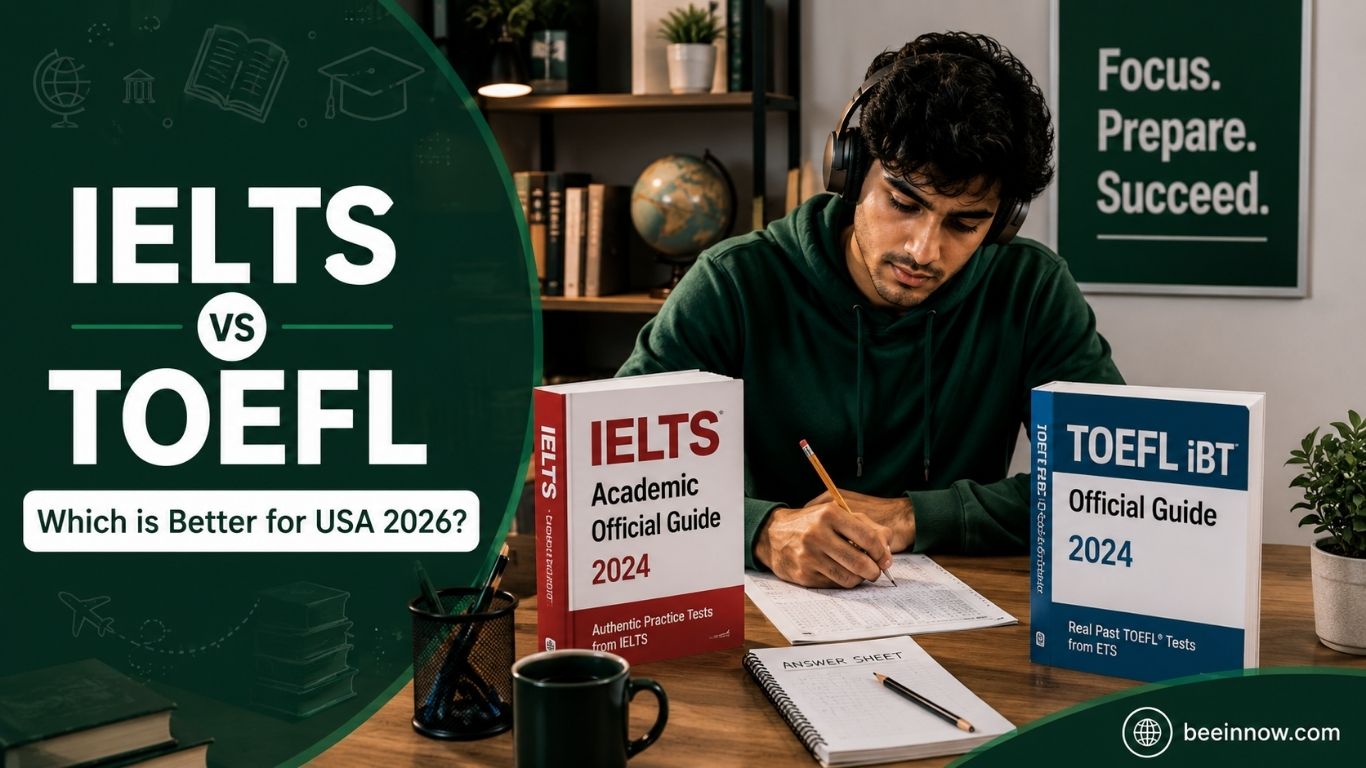
IELTS vs TOEFL for USA universities is the question every international student faces — and in 2026, there is a critical update that most online comparison guides have not yet addressed. As of January 21, 2026, the TOEFL iBT has moved to an entirely new 1–6 band scoring scale, replacing the familiar 0–120 system that had been in use for decades. If you are reading an IELTS vs TOEFL guide that still references TOEFL scores out of 120, you are reading outdated information.
The good news: over 3,400 US institutions now accept IELTS, including every Ivy League university, MIT, Stanford, and virtually every top-100 US program. TOEFL is accepted by most major US universities as well. Both tests are genuinely equivalent in the eyes of US admissions committees — the question is which one gives you the best chance of hitting the score you need, based on your specific strengths and test-taking style. This guide covers everything you need to make that decision with confidence.
What’s New in IELTS vs TOEFL for USA Universities in 2026?
Before comparing the two tests, it is essential to understand the significant changes that have reshaped the IELTS vs TOEFL landscape in 2026.
The most significant change is the TOEFL iBT’s new 1–6 band scoring scale, introduced on January 21, 2026. The old 0–120 scale has been replaced with a system that uses half-point increments (3.5, 4.0, 4.5, 5.0, 5.5, 6.0) and aligns directly with CEFR proficiency levels. Your overall TOEFL score is now the average of your four section scores rounded to the nearest half point. During the 2026–2028 transition period, score reports will show both the new 1–6 scale and the old 0–120 equivalent — so you can cross-reference with university requirements that may still list old-scale minimums.
The TOEFL test itself has also become significantly shorter — approximately 90 minutes, down from the previous two-hour-plus format. The reading section now uses adaptive testing, adjusting difficulty based on your performance in real time. These changes make the 2026 TOEFL a considerably different experience from what most preparation guides describe, so ensure your study materials are genuinely current.
IELTS, meanwhile, has continued its rapid expansion in the USA. Over 3,400 US institutions now accept IELTS scores — a figure that has grown significantly over the past three years. All eight Ivy League universities, MIT, Stanford, and virtually every major graduate program in the country now accepts IELTS Academic on equal terms with TOEFL.
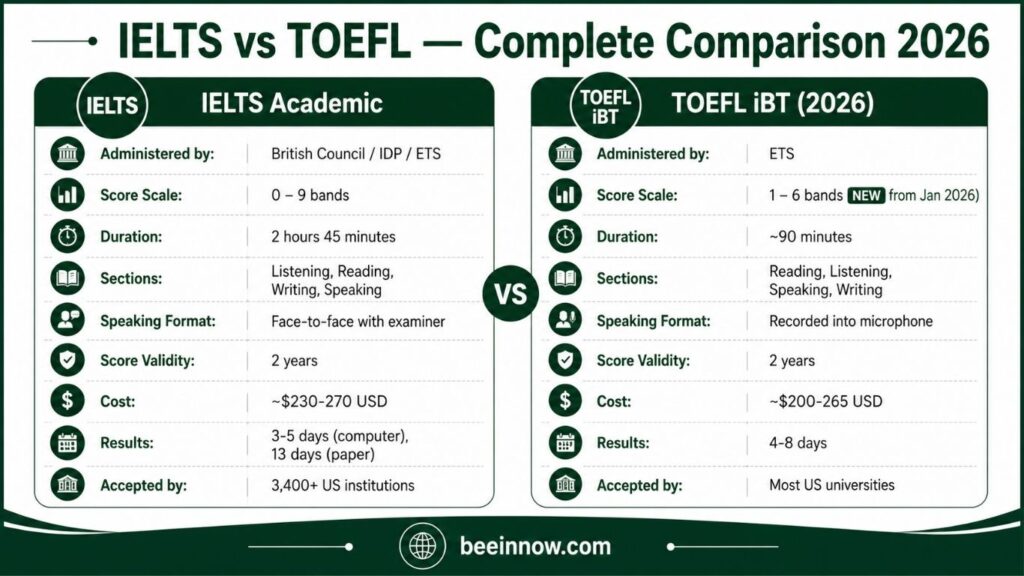
IELTS vs TOEFL for USA Universities — Key Differences
| Factor | IELTS Academic | TOEFL iBT (2026) |
|---|---|---|
| Administered By | British Council / IDP / ETS | ETS (Educational Testing Service) |
| Score Scale | 0 – 9 bands | 1 – 6 bands (new from Jan 2026) |
| Test Duration | 2 hours 45 minutes | ~90 minutes |
| Sections | Listening, Reading, Writing, Speaking | Reading, Listening, Speaking, Writing |
| Speaking Format | Face-to-face with human examiner | Recorded into microphone (no examiner) |
| Reading Format | 3 long academic passages, 40 questions | Adaptive — adjusts to your performance |
| Calculator Allowed | ❌ No | ❌ No |
| Test Format | Computer or paper-based | Fully computer-based |
| Cost (approx.) | $230 – $270 USD | $200 – $265 USD |
| Score Validity | 2 years | 2 years |
| Results Timeline | 3-5 days (computer), 13 days (paper) | 4-8 days |
| US Institutions Accepting | 3,400+ | Most major US universities |
| Competitive Score (USA) | 6.5 – 7.5+ | 4.5 – 5.0+ (new scale) |
The most important practical difference between IELTS and TOEFL for USA universities is not the score scale or the test duration — it is the speaking format. IELTS Speaking involves a face-to-face conversation with a human examiner lasting 11 to 14 minutes, divided into three parts: personal questions, a short presentation on a given topic, and a structured discussion. TOEFL Speaking requires you to record responses into a microphone within strict time limits — 15 to 60 seconds per task — with no human present and no opportunity for clarification or natural conversation flow.
This single difference is the most decisive factor for most international students. Students who are naturally conversational and comfortable with face-to-face interaction tend to perform better on IELTS Speaking. Students who find human interviews pressurising — or who are more comfortable with structured, timed computer responses — tend to perform better on TOEFL. Indian students, in particular, often find IELTS Speaking more natural because the conversational format allows follow-up questions and a human connection that many Indian students are comfortable with.
💡 Pro Tip: Take a full practice test for both IELTS and TOEFL before deciding. Your score differential across the two practice tests is the clearest, most reliable signal of which test will deliver your best result.
IELTS vs TOEFL Score Requirements for Top USA Universities
Understanding the minimum score requirements for IELTS vs TOEFL at USA universities helps you set your preparation target accurately from the start. Note that TOEFL scores below are given on the new 2026 1–6 scale:
| University | Minimum IELTS | Minimum TOEFL (new scale) | Program |
|---|---|---|---|
| Harvard University | 7.0 (7.5+ for some programs) | 5.0+ | Graduate programs |
| Stanford University | 7.0 (7.5+ for GSB) | 5.0+ | Graduate programs |
| MIT | 7.0+ | 5.0+ | Graduate programs |
| Columbia University | 7.0 (7.5 for Journalism) | 4.5 – 5.0 | Graduate programs |
| NYU | 6.5 – 7.0 | 4.5+ | Graduate programs |
| University of Michigan | 6.5+ | 4.5+ | Graduate programs |
| Georgia Tech | 6.5+ | 4.0+ | Engineering/CS MS |
| Purdue University | 6.5+ | 4.0+ | Graduate programs |
| Arizona State University | 6.5+ | 4.0+ | Graduate programs |
A few important observations from this data. Harvard Kennedy School requires IELTS 7.5+, and Harvard Medical School requires 7.5 overall — above the general Harvard minimum of 7.0. Columbia Journalism requires IELTS 7.5. Always check program-specific requirements, not just the university’s general minimum — different departments within the same university often have different thresholds, and the most competitive programs almost always require scores above the institution’s published minimum.
It is also worth noting that some programs specify minimum section scores, not just overall scores. Engineering and Business programs in particular sometimes require higher writing or speaking section scores independently. A student who scores IELTS 7.0 overall but only 6.0 in Writing may be rejected from a program that requires Writing 6.5 or above, even though the overall band meets the minimum.
IELTS vs TOEFL Score Conversion — 2026 Updated Chart
Since IELTS and TOEFL use entirely different scoring scales, students often need to understand how their scores compare when evaluating university requirements. The ETS official conversion chart provides the most reliable mapping between the new TOEFL 1–6 scale and IELTS bands:
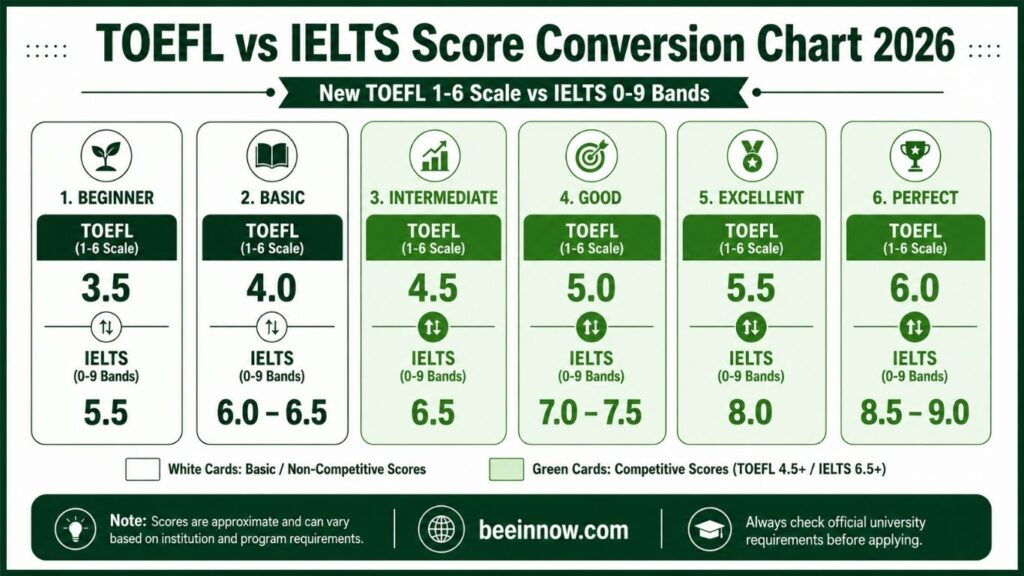
A TOEFL score of 5.0 on the new scale corresponds approximately to IELTS 7.0–7.5 — which is the competitive range for most top US graduate programs. A TOEFL score of 4.5 corresponds approximately to IELTS 6.5 — the minimum for most mid-tier programs. Use the official ETS TOEFL-to-IELTS conversion tool to check your specific score equivalency against the requirements of each program on your list.
IELTS vs TOEFL — Which is Easier for International Students?
The difficulty question is the most searched aspect of IELTS vs TOEFL for USA universities — and the honest answer is that neither test is universally easier. Difficulty is entirely subjective and depends on your specific strengths, your native language, and your comfort with different question formats.
IELTS tends to be easier if you:
- Are comfortable with face-to-face speaking and natural conversation
- Prefer handwriting or paper-based formats
- Struggle with American accents (IELTS uses varied global accents)
- Are stronger in descriptive writing and open-ended answers
- Find multiple-choice questions stressful
TOEFL tends to be easier if you:
- Are comfortable with computer-based tests and typing
- Prefer multiple-choice questions over open-ended responses
- Are already exposed to North American academic English
- Find face-to-face examiner interviews pressurising
- Are strong in logical reading comprehension
For Indian students specifically, the IELTS Speaking section is generally considered more manageable — the conversational format allows natural pauses, clarification requests, and human interaction that many Indian students find less stressful than speaking into a microphone within strict time limits. The IELTS Reading section, which requires skimming and scanning long academic passages for specific information, can be challenging for students not accustomed to this style — but it rewards practice effectively.
IELTS vs TOEFL — Which is More Accepted at USA Universities?
TOEFL has historically been the more established test in the USA — it was developed by ETS specifically for American university admissions and has been the standard for decades. However, the gap has narrowed dramatically. Over 3,400 US institutions now accept IELTS, including every Ivy League university and virtually every top-100 program.
For the vast majority of international students applying to US universities in 2026, both tests are equally accepted and equally valid. The practical advice is simple: verify acceptance on the specific admissions page of each program you are applying to, not just the university’s general page. A small number of specialised programs or state colleges may still list TOEFL only — particularly older institutions or community colleges that have not updated their admissions policies in line with IELTS’ expanded US acceptance.
If you are applying to both US and non-US universities simultaneously — particularly UK, Canada, or Australia — IELTS is the more versatile choice. It is the primary English test for UK immigration (UKVI IELTS specifically), Canadian immigration pathways, and Australian university admissions. Taking IELTS covers all these destinations with a single test, while TOEFL is less widely accepted outside the USA.
⚠️ Important: For UK student visa applications, you must take the UKVI-approved IELTS variant specifically — standard IELTS Academic is not accepted for UK visa purposes. This is a common and costly mistake. If you plan to study in the UK after the USA, verify which IELTS variant each pathway requires.
IELTS vs TOEFL — Fees and Logistics in 2026
Test fees for IELTS and TOEFL are broadly comparable in 2026. TOEFL iBT costs approximately $200–$265 USD depending on your country (approximately ₹18,000 including GST in India). IELTS Academic costs approximately $230–$270 USD depending on your country (approximately ₹19,000 in India). Both fees include score reports to a small number of recipient institutions — additional score reports cost extra for both tests.
TOEFL delivers results faster — typically 4 to 8 days after the test. IELTS results on computer-delivered tests are available in 3 to 5 days, while paper-based IELTS takes up to 13 days. If you are applying close to a deadline, computer-delivered IELTS or TOEFL are both faster than paper IELTS.
Both tests are valid for two years from the test date — there is no extension mechanism for either. Plan your test date accordingly to ensure your scores are still valid when your applications are reviewed. IELTS is available up to 48 times per year across its testing network, while TOEFL has approximately 8 test dates per month. If test availability in your city is limited, IELTS typically offers more scheduling flexibility.
How to Prepare for IELTS vs TOEFL for USA Universities
Preparation strategy for IELTS vs TOEFL differs meaningfully between the two tests — and the most important first step is to take a full diagnostic practice test for each before committing to either. Your relative performance on the two practice tests is the single most reliable indicator of which test will deliver your best result.
For IELTS preparation, the official Cambridge IELTS Practice Tests series (Books 1–18) provides the most accurate simulation of the actual test. For Speaking preparation, practice with a human partner — ideally a native or fluent English speaker who can give you genuine conversational feedback. The Speaking section rewards natural, flowing conversation, not rehearsed answers — practice improvising on unfamiliar topics rather than memorising responses.
For TOEFL preparation, start with the official ETS materials for the new 2026 format — specifically the updated Official TOEFL iBT Tests volumes that reflect the new 1–6 scoring scale and shorter test duration. Many older preparation books still reference the 0–120 scale and the longer test format — using outdated materials is one of the most common and avoidable preparation mistakes in 2026. Magoosh’s TOEFL preparation platform is widely regarded as one of the most effective third-party resources for the current test format.
For more guidance on your complete US university application strategy, explore our related articles on MS in USA Complete Guide, GRE vs GMAT Complete Guide, How to Write a Perfect SOP, and Top Universities in USA.
Frequently Asked Questions — IELTS vs TOEFL for USA Universities
Is IELTS or TOEFL better for USA universities?
Both are equally accepted at virtually all major US universities in 2026. The better test is whichever one you score higher on — take a practice test for each and let your results decide.
What is the minimum IELTS score for US universities?
Most US universities require a minimum IELTS score of 6.5 for graduate programs, with competitive programs at Harvard, MIT, and Stanford typically expecting 7.0 to 7.5 or above.
What is the new TOEFL scoring scale in 2026?
As of January 21, 2026, TOEFL iBT uses a new 1–6 band scale with half-point increments, replacing the old 0–120 system. A score of 4.5 corresponds approximately to IELTS 6.5, and 5.0 corresponds to IELTS 7.0–7.5.
Which is easier — IELTS or TOEFL?
Neither is universally easier. IELTS tends to suit students who prefer face-to-face speaking and open-ended questions. TOEFL suits students comfortable with computer-based tests and multiple-choice formats. Indian students often find IELTS Speaking more natural due to its conversational format.
Can I use IELTS for an F-1 student visa?
Yes — the F-1 visa does not require a specific English test. Your university’s admission requirement determines which test you need. If your university accepted your IELTS score for admission and issued your I-20, your F-1 visa application proceeds on that basis.
Final Thoughts
IELTS vs TOEFL for USA universities in 2026 comes down to one practical question: which test gives you the best chance of scoring above your target universities’ minimum requirements? Both are equally valid, equally accepted, and equally respected. The decision should be driven entirely by your strengths — not by assumptions about which test is easier in general.
Take practice tests for both, compare your results honestly, choose the test that gives you a meaningful score advantage, and invest your preparation time in that test alone. A strong score on either test, presented as part of a well-rounded application, gives you a genuine competitive advantage at top US programs. Browse US colleges and their specific test requirements at beeinnow.com.
For official test information, always refer directly to the ETS TOEFL official website and the official IELTS website for the most current fees, dates, score policies, and 2026 format details.