Three things changed for anyone applying to Cornell University degrees this year, and most guides haven’t caught up yet. The Board of Trustees approved a fresh tuition increase for 2026-27. The TOEFL exam itself switched to a new scoring scale for tests taken from January 2026 onward. And the acceptance rate — already brutal a decade ago — has kept sliding. None of this is speculation; it’s pulled directly from Cornell’s own recent announcements.
What Does Cornell University degrees Actually Cost in 2026-27?
Cornell’s Board of Trustees approved undergraduate tuition of $73,946 a year for 2026-27 at its endowed colleges — Architecture Art and Planning, Arts and Sciences, the Cornell Bowers College of Computing, and Engineering — a 3.76% increase over the prior year. That figure applies to out-of-state and international students across the board. Living expenses add substantially more: Cornell’s own 2026-27 estimate for international undergraduates runs $27,507 a year, while international graduate students should budget closer to $37,418. Add tuition and living costs together for Cornell University degrees at the undergraduate level and you’re looking at roughly $101,000 for a single year, before books, health insurance, or travel.
💡 Pro Tip: Nearly half of Cornell’s undergraduates receive need-based financial aid, and families earning up to $125,000 with typical assets can have tuition fully covered by grants. It’s worth applying for aid even if you assume you won’t qualify — the threshold is higher than most applicants expect.
How Competitive Is Cornell Right Now?
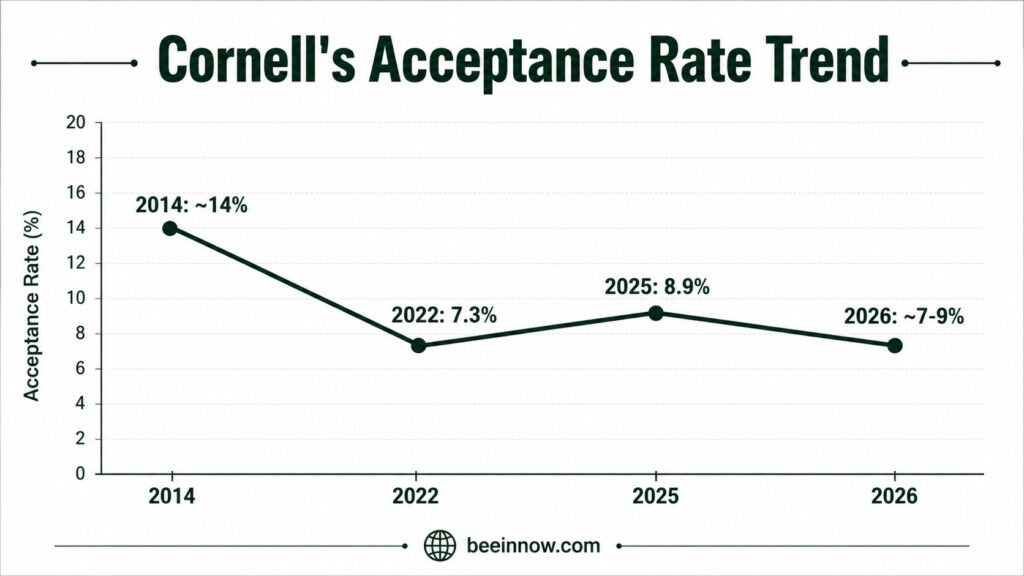
The trend line matters more than any single year’s number. Cornell’s acceptance rate sat around 14% back in 2014 and has fallen fairly steadily since, driven mostly by application volume rather than a shrinking class size — Cornell still enrolls roughly 3,200 to 3,500 new undergraduates each year despite receiving over 70,000 applications recently, up from around 17,000 a year in the 1980s. Different sources report slightly different figures for individual years (anywhere from 7% to 9% depending on the cycle and whether early or regular decision is included), but the direction is consistent: getting into any of the Cornell University degrees at the undergraduate level has gotten harder every year for a decade. Within that, Cornell is still considered one of the more accessible Ivies — noticeably less selective than Harvard or Stanford, which sit in the 3-4% range.
The TOEFL Scoring Change You Need to Know About
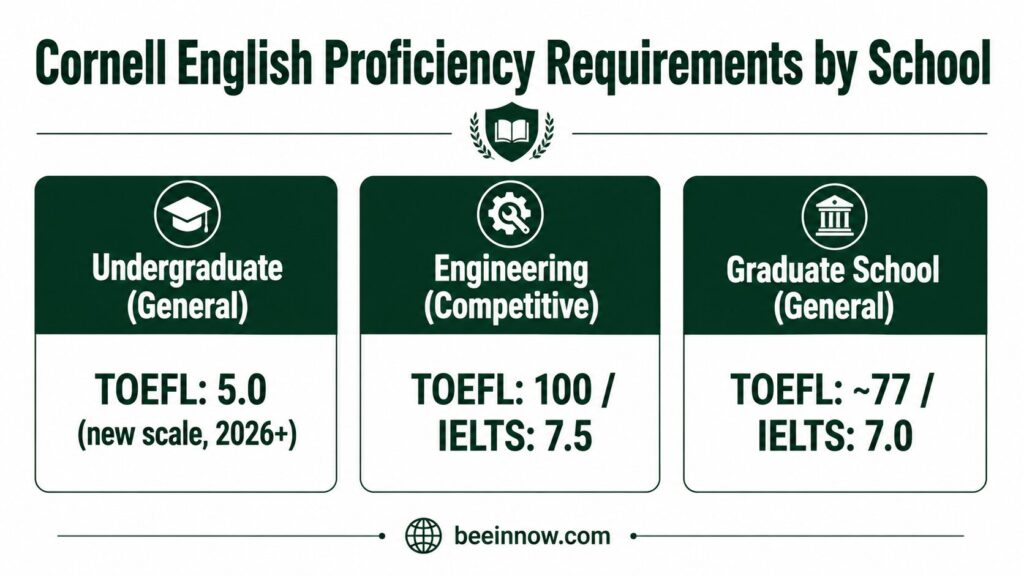
This is the part most existing guides haven’t updated for. Cornell’s undergraduate admissions page now states that TOEFL exams taken in January 2026 or later are scored on a new scale, with a minimum score of 5.0 and a recommended score of 5.5. If you’re prepping with an older guide that references the traditional 0-120 TOEFL scale, double-check which version applies to your specific test date — submitting under the wrong assumption is an easy, avoidable mistake.
⚠️ Warning: Requirements are not uniform across Cornell. The Cornell Bowers College of Computing and the College of Engineering set a noticeably higher bar — a minimum TOEFL of 100, IELTS of 7.5, or Duolingo of 130 for undergraduate applicants — well above the general university minimum.
What About Graduate Programs?
For most graduate Cornell University degrees, the Graduate School requires a TOEFL score built from section minimums — writing 20, listening 15, reading 20, and speaking 22, which totals roughly 77 — or an IELTS overall band score of 7.0, unless you qualify for a standing exemption. Some individual graduate fields set higher requirements or ask for an interview, so check your specific program rather than assuming the general policy applies. Around 60% of the student population in professional graduate programs like the Brooks School of Public Policy is international, which says something about how normalized the F-1 visa process is on campus by the time you arrive.
| Item | 2026-27 Figure | Notes |
|---|---|---|
| Undergraduate Tuition (Endowed Colleges) | $73,946/year | 3.76% increase over prior year |
| Undergraduate Living Expenses (Int’l) | $27,507/year | Official Cornell estimate |
| Graduate Living Expenses (Int’l) | $37,418/year | Official Cornell estimate |
| Undergraduate TOEFL (General) | 5.0 min / 5.5 recommended | New scale, for exams from Jan 2026+ |
| Engineering & Computing TOEFL | 100 min | Traditional scale; IELTS 7.5 / Duolingo 130 also accepted |
| Graduate School TOEFL (General) | ~77 (section minimums) | Writing 20, Listening 15, Reading 20, Speaking 22 |
| MBA Acceptance Rate | ~20% | Considerably higher than undergrad admissions |
Which Cornell University degrees Draw the Most International Interest?
Among Cornell University degrees, Computer Science, Engineering, the MBA through the SC Johnson College of Business, Architecture, Public Policy, and Hotel Administration through the Nolan School consistently pull the strongest international applicant pools — largely because they combine strong name recognition with genuinely competitive post-graduation outcomes. The MBA specifically runs its own admissions cycle with an acceptance rate around 20%, considerably higher than undergraduate admissions but still selective by most standards.
Frequently Asked Questions
What is Cornell’s acceptance rate for international students?
Cornell doesn’t publish a separate international acceptance rate, but international applicants generally face somewhat tighter competition than domestic applicants within an overall rate that has hovered between 7% and 9% recently.
How much do Cornell University degrees cost for international students?
Undergraduate tuition for 2026-27 is $73,946 a year, plus an estimated $27,507 in living expenses — roughly $101,000 total before books and insurance. Graduate costs vary by program.
What TOEFL score does Cornell require?
It depends on the school. The general undergraduate minimum is 5.0 on the new scale used from January 2026 onward, while Engineering and Computing require a much higher TOEFL of 100 (or IELTS 7.5) on the traditional scale.
Is Cornell need-blind for international applicants?
No — Cornell’s need-blind policy applies to domestic applicants. International applicants are reviewed with financial need as a factor, so budgeting realistically matters more if you’re applying from outside the US.
What is Cornell known for academically?
Computer Science, Engineering, the SC Johnson MBA, Architecture, Public Policy through the Brooks School, and Hotel Administration are among the degrees that draw the strongest international interest.
Final Thoughts
Applying to Cornell University degrees in 2026 means dealing with three moving targets at once: rising tuition, a shifting TOEFL scale, and an acceptance rate that keeps trending down. None of that should scare you off — Cornell remains one of the more accessible Ivies, and financial aid genuinely does cover full tuition for a meaningful share of admitted students. It just means double-checking the current-year numbers directly on Cornell’s own site rather than trusting a guide written even a year ago, since apparently that includes this one eventually too.
Related reading: Check out our guides on USA Student Visa Guide and Scholarships for International Students for more on planning your application and funding.